Five minutes with Nick Alsop on Green Star Buildings
29 Apr 2026
We spent five minutes with Nick Alsop, Senior Manager Market Engagement, for an update on Green Star Buildings. With the tool transitioning from Green Star Buildings v1 to v1.1on 1 May, Nick looks back on how industry moved from doubt to determination in the face of challenges, shares which sectors that are leading the way with integrated approaches to certification and lays out his vision for a certification that nurtures community and nature.
Nick, what can you tell us about the sectors and building types that are leading the uptake of Green Star Buildings?
For a long time, sustainability rating tools for buildings were associated with cities, office towers and individual or one-off certifications, but this is no longer the case. In recent years - and especially since Green Star Buildings was launched in 2020 – we’ve seen over 800 registrations across a variety of sectors and building types. The build-to-rent and living sectors have embraced Green Star Buildings with real enthusiasm and today more than a third of Australia’s Build-to-Rent pipeline is registered for Green Star Buildings. By taking a long-term view - reducing operational costs, building in resilience measures and future-proofing for a changing climate - they're delivering value that both attracts investment, and enhances livability. You can read more about that in our recent publication, “Keys to change”. Freight, logistics and industrial projects continue to surge ahead and then we’re seeing more Green Star projects enter communities at a grass roots level too.
Can you tell us more about the government leadership you’re seeing and the diversity of projects coming through from this sector?
Having worked in government roles previously, I've been excited to see the uptake of Green Star in this sector. Worthy of a mention are two projects at the forefront of Green Star Buildings – Yitpi Yartapuultiku by City of Port Adelaide and Maribyrnong City Council's Civic Precinct and Community Hub in Victoria – and their recent 6 Star Green Star Buildings certifications. These are the second Australian buildings to this reach this mark of world leadership and both are community facilities that can be enjoyed for years to come.
We have seen a steady flow of leisure and sport centres register, and the NSW Department of Education is to be commended for their ongoing certification of a growing number of schools. Likewise, Homes Victoria has been very active embedding Green Star into new social housing projects, as part of Victoria’s Big Build. In the health sector, public hospitals have emerged as one of the early adopters of Buildings v1.1 with registrations now received for two Western Australian hospitals and more underway in other states.
Government at all levels continues to impress us with innovation and ambition.
We’re also seeing more precinct-scale and integrated approaches to ratings. What can you tell us about this work?
The whole-of-precinct certification approach is certainly on the rise. One longstanding project doing this is Renewal SA’s Bowden community in Adelaide, which is a 6 Star Green Star Community where all buildings within it must also be Green Star rated. Here in Victoria, Fitzroy Gas Works on Wurundjeri Woi Wurrung Country is an emerging Green Star certified, fossil fuel free neighborhood of affordable, sustainable housing and infrastructure close to public transport, schools and amenities.
Another example of how Green Star is evolving from single, one-off certifications to supporting large, integrated precincts is Bradfield City Centre, home to community, warehouse and office spaces guided by sustainable, Country-led design. Also in Western Sydney is Endeavour Energy’s 6 Star Green Star rated fitout, within a 6 Star Green Star certified building at 8 Parramatta Square, which itself is part of a Green Star community.
Green Star is no longer about one building at a time - it’s also about whole precincts, and the buildings and places that make them a community. We are excited to be working with the first two Green Star Communities v2 projects, taking this to the next level.
On 1 May we’re transitioning to Green Star Buildings 1.1. How have industry attitudes changed since v1 was launched and how will it continue to transform the built environment?
It's been a genuine joy watching project teams move from doubt to determination around challenges like electrification. Over time I've witnessed teams initially question whether it was even possible, then rising to the challenge of finding new solutions, then paving the way for others to follow. Industry has made this happen, and industry deserves full credit in both supporting the evolution of the tools, and then getting stuck in and making it happen on their projects. It gets to the heart of the relationship between industry and rating tools, as we all strive to transform our built environment.
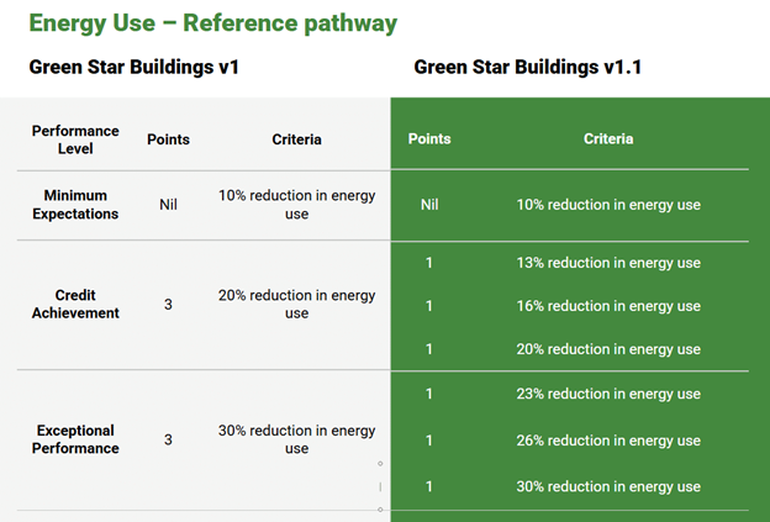
Like all Green Star tools, the next iteration of Green Star Buildings was developed with and for industry. While it continues to sharpen the focus on climate action, nature and circularity, it’s also more user-friendly and makes certification more accessible. A particular standout for me is the introduction of stepped points which give points to projects once they meet certain benchmarks within selected credits. You can see an example below for the energy use credit.
Fast forward five years – what industry outcomes do you hope to see from version 1.1?
Looking ahead, I’d hope to see nature brought firmly to the fore, with genuinely nature‑positive outcomes becoming standard practice. Closely linked to that is a stronger and more visible recognition of the role of First Nations, with their knowledge and leadership reflected in both design and delivery decisions. There’s also more to do when it comes to circular economy outcomes - I’d like to see projects increasingly designed for adaptability, reuse and end‑of‑life thinking from day one. If version 1.1 helps embed those principles into everyday decision‑making, that would be an outcome we can all be proud of.
Green Star Buildings is built for what’s next. You can find out more about version 1.1 here.